

Implementation Builds Programmes. Design Builds Institutions.
Why the biggest breakthroughs often happen before implementation begins

There is a pattern I keep noticing.
A problem surfaces. Experts are assembled. The people in the room are accomplished, trusted, and have built extraordinary things under difficult constraints. Recommendations are submitted. Reforms are announced. The problem recurs—sometimes in a different form, sometimes in exactly the same one.
The recommendations differed. The frame did not.
The Pattern
This is not a failure of execution. It is a failure of framing.
The question being asked is almost always: how do we do this better at scale? That is an implementation question. It receives an implementation answer — better technology, stronger protocols, more oversight, faster processes.
The question not being asked is almost always: should this be designed differently? That is an institutional design question. It rarely appears on the committee’s terms of reference.
The Broader Pattern
The limitation emerges when every problem is implicitly framed as an implementation problem.
Education becomes a problem of conducting exams at scale.
Skilling becomes a problem of training more people.
Innovation becomes a problem of funding more startups.
Governance becomes a problem of digitization.
Employment becomes a problem of creating more schemes.
Research becomes a problem of allocating more grants.
Each framing is not wrong — it identifies something real. But each framing also closes off a different set of questions before they are asked.
We ask:
How do we do this better?
How do we scale this?
How do we monitor this?
How do we make this more efficient?
We ask far less often:
Are we solving the right problem?
Is this the right institution?
What incentives are we creating?
What capabilities are missing?
What assumptions are embedded in the design?
What should we deliberately choose not to do?
The first set are implementation questions. The second set are institutional design questions. They are not the same thing — and confusing them is not a minor error. It determines what kinds of solutions become visible, what kinds of expertise get recruited, and what kinds of committees get appointed.
Two Sides of the Same Coin
Perhaps the greatest organizational strength and its binding limitation are two sides of the same coin.
An organization that becomes exceptional at implementation under constraints gradually begins to frame problems in ways that are amenable to implementation. The better it becomes at building systems, the more likely it is to see every challenge as a systems-building exercise.
Over time, we produce more system builders than system designers.
Neither is more important than the other. We need both. But they ask fundamentally different questions.
System builders ask: How do we build this better?
System designers ask: Should we build this differently?
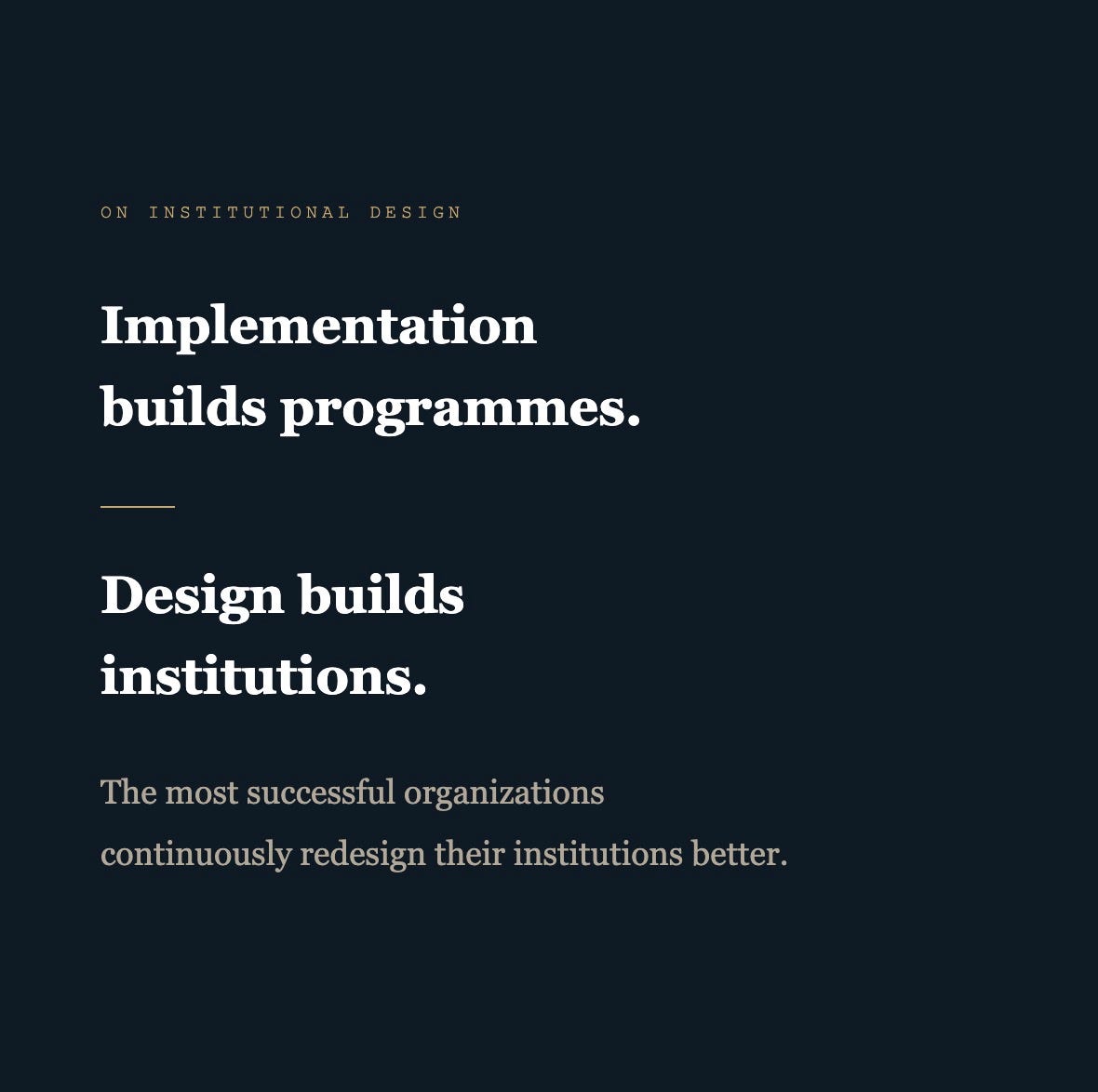
Implementation builds programmes. Institutional design builds institutions.
The most celebrated achievements in any organization tend to be implementation breakthroughs — a well-defined problem, a technology solution, measurable outcomes at scale. They get cited so often precisely because they fit the frame perfectly.
What gets cited far less often: the institutional reforms that didn’t happen, the capabilities that were never built, the systems that still don’t work. Those are harder to put in a slide because they don’t have a launch date or a transaction count. They are the absence of something rather than the presence of something — and absence doesn’t photograph well.
The achievements we celebrate are not proof that we are capable of becoming what we aspire to be. They are proof that we can implement when the problem is framed correctly for implementation. The harder question is what happens to the problems that can’t be framed that way.
The Question Worth Asking
Perhaps the developmental journey of organizations, institutions, and nations is not merely a transition from scarcity to abundance or from inefficiency to efficiency. It is also a transition from implementation capacity to institutional capacity.
Building systems matters. Scaling them matters. Implementing them better matters.
But there comes a point when the harder question is no longer, “Can we build this better?” It becomes, “Can we continuously learn, adapt, and redesign when our institutions need to evolve?”
Implementation builds programmes. Institutional design builds institutions. Institutional learning sustains them.
Developed institutions do not merely implement better. They continuously learn, adapt, and redesign themselves better.